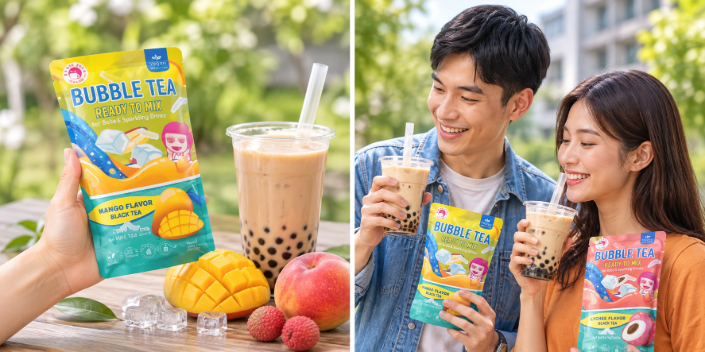
When evaluating bubble tea products for international retail, buyers consider more than flavor, pricing, and supply reliability. Product labels, ingredient information, and third-party recognition can also influence selection.
Terms such as Vegan, Gluten-Free, Clean Label, and international food awards may appear together in product descriptions. However, they communicate different types of information.
Confusing an ingredient characteristic with a product certification or a taste award can mislead consumers and create labeling or marketing risks.
For distributors and beverage brands, understanding these distinctions helps establish a more credible product selection and communication process.
What Do Vegan, Gluten-Free, Clean Label, and Taste Awards Mean?
| Claim or Recognition |
Main Purpose |
What Buyers Should Verify |
| Vegan |
Suitability under applicable vegan criteria |
Complete ingredients, processing aids, production conditions, certification |
| Gluten-Free | Compliance with destination-market gluten-free labeling rules | Ingredients, cross-contact controls, relevant testing and documentation |
| Clean Label | A positioning concept associated with ingredient simplicity or transparency | Actual formulation and substantiation for specific claims |
| International Taste Awards | Recognition awarded to a particular evaluated product | Awarded SKU, year, award level, and logo usage rights |
These categories may complement one another, but none automatically establishes compliance with the others.
1. Vegan Claims Require a Review of the Entire Product
Plant-based beverages and vegan products are related, but they are not necessarily identical.
For bubble tea, replacing dairy milk with oat or almond milk is only one part of formulation review.
Creamers, flavorings, syrups, toppings, and other ingredients may also need to be evaluated, depending on the intended vegan standard.
Brands wishing to display a third-party vegan certification mark must meet the requirements of the relevant certification program.
For example, The Vegan Society's Vegan Trademark Standards address animal-derived ingredients as well as aspects of development, manufacturing, and cross-contamination management.
International buyers should therefore rely on complete product specifications and relevant certification documents rather than assuming that a product qualifies simply because it contains a plant-based milk.
2. Gluten-Free Claims Cannot Be Based on Tapioca Starch Alone
Tapioca starch is commonly used in traditional bubble tea pearls.
However, the use of tapioca starch does not automatically establish that the finished bubble tea product complies with gluten-free labeling requirements.
Milk tea powders, flavorings, toppings, and other ingredients may introduce additional considerations. Manufacturing and handling processes may also create opportunities for gluten cross-contact.
In the United States, the FDA's gluten-free labeling rule establishes ingredient-related conditions and requires any unavoidable gluten presence to remain below 20 parts per million.
Requirements for other markets must be reviewed under the applicable local rules.
When adequate supporting documentation is unavailable, brands should avoid making a gluten-free claim based solely on the primary starch used in the pearls.
3. Clean Label and A.A. Taste Awards Serve Different Purposes
Clean Label is commonly used to describe an approach that emphasizes ingredient transparency, simpler formulations, or the reduction of certain additives.
It is not a single globally standardized food certification.
The A.A. Taste Awards, by contrast, are a food evaluation program built around a clean-label philosophy. The awards consider sensory and product attributes, including appearance, aroma, taste, texture, and composition.
According to the A.A. Taste Awards organization, the program recognizes food and beverage producers while emphasizing flavor quality and efforts to limit artificial additives.
However, winning a taste award does not automatically grant a product vegan, gluten-free, or every form of additive-free certification.
Award programs and certification schemes have distinct standards and authorization requirements.
Before displaying an award in retail materials, buyers should verify the exact awarded product, award year and level, and the conditions governing the use of the award mark.
This prevents product descriptions from implying benefits or certifications beyond the award's actual scope.
4. How Retailers Can Apply These Labels in Product Selection
Consider a distributor planning to expand its plant-based bubble tea assortment.
A practical evaluation process can be divided into three stages.
Identify the Consumer Requirement
Determine whether the target audience is primarily interested in plant-based milk tea, products suitable for a particular dietary restriction, or tea beverages with recognized taste credentials.
Each requirement calls for different purchasing criteria.
Review Product Documentation
Request the complete ingredient list, allergen information, relevant testing or certification records, and confirmation of which claims may be used.
For imported products, the buyer should also ensure that the required labeling and documentation meet destination-market rules.
Communicate Verified Product Features
Product pages, menus, and shelf labels should explain flavors, principal ingredients, and verified product characteristics in language shoppers can easily understand.
Award marks should appear only when the specific product and intended use are covered by the relevant authorization.
Vegan or gluten-free claims should likewise be supported by appropriate product information and evidence.
This creates clearer communication for customers and a more manageable documentation process for retailers.
5. BOBA CHiC's Experience in Beverage Products and International Recognition
Founded in 2018, BOBA CHiC is a Taiwanese bubble tea brand built on more than 20 years of beverage manufacturing experience.
The company develops bubble tea, tea beverages, and related products for markets beyond Taiwan.
Its official brand information lists recognition from the International Taste Institute, Great Taste, Monde Selection, and the A.A. Taste Awards.
These achievements offer insight into the brand's background in flavor development and product evaluation.
However, any commercial use of an award should be tied to the specific awarded product and applicable logo permissions.
Similarly, a vegan or gluten-free claim for an individual product must be assessed through the relevant formulation and manufacturing documentation. Brand-level recognition cannot be treated as certification of the entire product range.
Build Trust Through Accurate Product Information
For international beverage brands, clear and verifiable product information provides a stronger foundation for long-term trust than an extensive collection of loosely explained labels.
Vegan claims, gluten-free labeling, and international taste awards each have a role, but each must be used within its proper scope.
If you are evaluating bubble tea products for retail or developing a private-label beverage range, explore the BOBA CHiC product portfolio or contact the BOBA CHiC team to discuss product specifications and sourcing requirements.