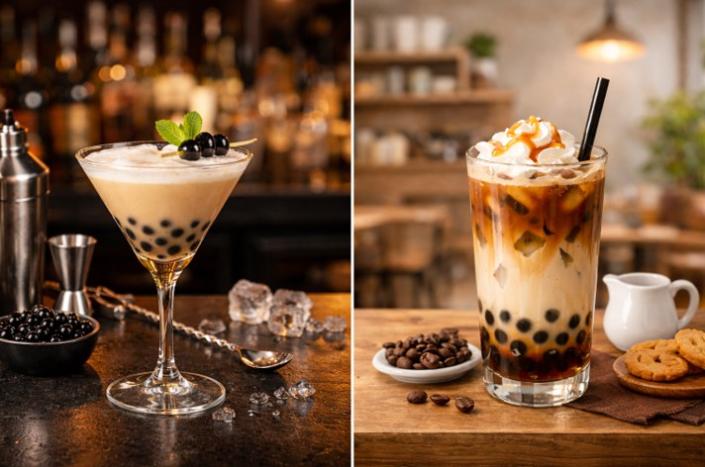
Most people first encounter popping boba in bubble tea. Behind a bar or café counter, it can play a different role: a small, visible ingredient that releases fruit flavor when the customer bites into it.
That makes popping boba useful for drinks that need one noticeable change without a completely new recipe. A gin and tonic can take on a fruit note. A cold brew can become a more distinctive signature drink. A seasonal menu can gain a new texture without adding another cooking process.
What Popping Boba Adds to a Drink
Popping boba contains a liquid filling inside a thin outer membrane. Unlike tapioca pearls, which are chewy throughout, it releases its flavor at the moment it breaks.
In a finished drink, it can provide three things:
- A fruit flavor that appears later than the base drink
- A soft burst of texture alongside liquid ingredients
- A visible ingredient that customers can identify before they take the first sip
The result depends on the product, drink temperature, acidity and serving time. A popping boba that works well in iced tea may not hold its shape in every cocktail or coffee drink, so testing is essential.
Using Popping Boba in Cocktails
The simplest application is to pair a fruit flavor with the main spirit.
Lychee popping boba can work with a clear gin and tonic, where the spheres remain visible in the glass and release fruit flavor as they are bitten. Passion fruit popping boba can be paired with a smoky whiskey drink, bringing acidity and sweetness after the initial whiskey and peat notes.
The timing matters. If the spheres break as soon as they are added, the drink loses the contrast between the base flavor and the fruit filling. If they remain intact for too long, customers may not notice the intended effect. Bartenders should test the drink at the point it will actually be served, not only immediately after preparation.
For alcoholic drinks, confirm that the product is suitable for the intended application. Standard non-alcoholic popping boba and alcoholic popping boba are different products and should not be treated as interchangeable.
A relevant commercial example is Boba POPS. In January 2025, Unifying Spirits announced the launch of its alcoholic popping boba product and stated that distribution would begin in California, Florida, Texas, Arizona, Georgia and Louisiana. The “first patented alcoholic popping boba” description comes from the company’s own announcement and should be presented as a brand claim.
Using Popping Boba in Coffee Drinks
Coffee drinks usually need a flavor that can stand beside bitterness and acidity. Peach, mango and berry popping boba can give sparkling coffee or iced coffee a fruit component that syrup alone cannot provide.
A simple menu test could combine:
- Sparkling coffee with peach popping boba
- Cold brew with milk foam and a floral fruit flavor
- Iced coffee with mango popping boba and a light citrus note
The purpose is not to add as many ingredients as possible. The drink should still taste like coffee. The popping boba should provide a clear contrast rather than cover the base flavor.
What to Check Before Adding It to the Menu
Before choosing a product, check four practical points.
- Holding time
How long does the popping boba remain intact after it is added to the drink? - Storage
Does the unopened product require refrigeration? What is the recommended period after opening? - Compatibility
Does it work with alcohol, carbonation, dairy, coffee acidity or citrus? - Portion cost
How many pieces go into one serving, and does the menu price cover the ingredient cost and preparation time?
These questions are more useful than simply asking whether the product looks attractive. A topping only works commercially when the bar team can use it consistently during service.
Ready-Made Popping Boba vs. Homemade Garnishes
| Consideration | Homemade Molecular Garnish |
Commercial Popping Boba |
| Preparation |
Requires ingredients, equipment and advance work | Usually portioned from the package |
| Consistency | Can vary between batches | Produced according to the supplier’s specification |
| Staff training | Requires more preparation knowledge | Easier to teach, depending on the product |
| Menu flexibility | Allows custom flavors and shapes | Offers consistent flavors and portions |
| Storage | Depends on the recipe and preparation method | Must follow the product label |
Commercial popping boba does not replace recipe development. It reduces one part of the preparation process, while the drink still needs testing, costing and staff instructions.
Start with One Drink
A practical first test does not require a full menu launch.
Choose one existing drink with a clear flavor profile. Test one popping boba flavor in two or three portion sizes. Record how the spheres hold up after five, ten and fifteen minutes. Then compare the taste, appearance, ingredient cost and preparation time.
If the result is consistent, the drink can become a seasonal special or a paid topping option. If it is not, the issue may be the drink base, serving temperature or holding time rather than the product itself.
Final Thoughts
Popping boba gives bars and cafes another way to add fruit flavor and texture to familiar drinks. Its strongest use is not decoration alone. It works when the burst of flavor has a clear place in the drink and the service team can prepare it consistently.
To test a new application, request a sample or contact us to discuss a cocktail, coffee or seasonal menu concept.