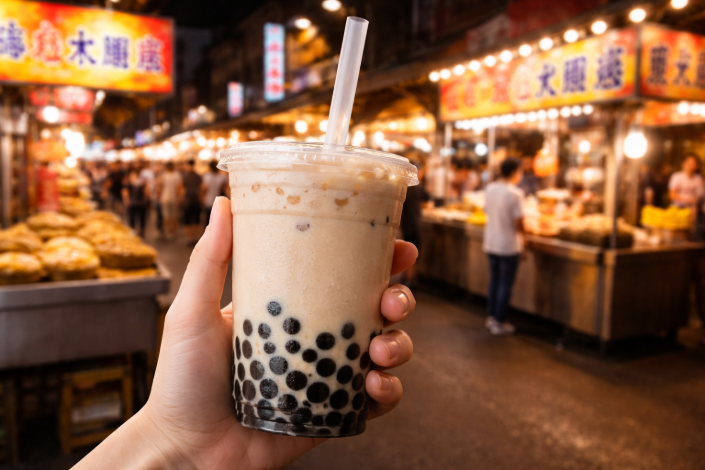
Bubble tea appeared in Taiwan in the 1980s. Nobody anticipated that this street drink would become part of daily life in more than sixty countries four decades later.
Bubble tea's rise to global prominence is one of the most unlikely food success stories of the past century. No multinational conglomerate funded it. No Hollywood placement deal introduced it to Western audiences. No coordinated international marketing campaign drove its spread. It traveled on word of mouth and the memory of biting through that first pearl.
The Starting Point: A Drink Built for Night Market Culture
Bubble tea spread through Taiwan quickly because it was perfectly matched to how people actually lived. It was affordable. You could drink it while walking. You did not need a table or a reservation. Taiwan's night markets were already social spaces, and this drink fit into them without friction.
Through the 1990s, Taiwan's hand-shaken beverage market expanded fast, and chain formats began to appear. The ability to adjust sweetness and ice level was a genuinely novel consumer experience at the time: the drink was yours to specify, not a fixed formula handed to you. That logic of personalization would be validated in market after market over the following decades, and it remains one of the core reasons bubble tea travels well across different consumer cultures.
The First Wave Out: Carried by Diaspora Communities
Bubble tea's first step outside Taiwan was not a brand expansion. It was people. Through the 1990s and into the early 2000s, as Taiwanese diaspora communities established themselves in North America, Australia, and Europe, bubble tea followed into Asian grocery stores and community restaurants.
The audience at this stage was specific: people who missed a taste from home. But something interesting started happening. Non-Asian neighbors came in. They brought friends. Those friends brought more people. Bubble tea was accepted for the first time by an audience it was not designed for, and the mechanism was not marketed. It was the experience of biting through a pearl. That chewable, drinkable combination was genuinely unfamiliar in Western beverage culture at the time, and unfamiliarity, when it is pleasurable, is memorable.
The Turning Point: Social Media Multiplied The Expansion Rate
If diaspora communities were bubble tea's first wave of global spread, Instagram and TikTok turned that wave into something significantly larger.
Bubble tea has a quality that most beverages cannot replicate: it photographs well without effort. The tiger stripe pattern of brown sugar syrup against milk. The cheese foam is sliding slowly down the side of a cup. The sensation of a popping boba breaking in your mouth, described in words, generates its own social transmission. Around 2018, brown sugar boba went viral across platforms globally, triggering a new wave of shop openings and allowing bubble tea to establish itself in markets with no existing Asian diaspora base.
This demonstrated something worth noting: bubble tea's spread no longer required the old pathway of diaspora community first, then broader consumer adoption. Visual transmission allowed it to enter any market with smartphones and curiosity, in any sequence.
Why Bubble Tea Crossed Cultures, and Why Taste Alone Does Not Explain It
Many popular foods and drinks fail to achieve genuine cross-cultural adoption because they are too embedded in a specific culinary context. Removed from that context, they lose their meaning. Bubble tea avoided this problem.
Its structure is simple enough to be universal: tea, milk, pearls. But that structure accommodates an enormous range of variation. Matcha with oat milk reads as Japanese. Thai milk tea with condensed milk reads as Southeast Asian. Sparkling fruit tea with popping boba reads as American. Every market can find its own version within the bubble tea framework without being required to accept a fixed correct interpretation.
That adaptability is the core reason bubble tea has taken root across such different food cultures. Good taste got people to try it. Flexibility is what kept it relevant everywhere it landed.
The Role of Taiwanese Manufacturing in Bubble Tea's Global Story
When bubble tea brands expand globally, there is a supply chain behind them that rarely gets discussed. How pearls are made. How tea is selected. How formulations maintain stability under ambient storage conditions across long shipping routes. These technical questions determine whether a bubble tea product that leaves a Taiwanese factory can actually deliver the experience a consumer expects after crossing half the globe.
Taiwan's position in this supply chain goes beyond being the category's birthplace. Four decades of hand-shaken beverage culture have given Taiwan a depth of manufacturing knowledge in pearl production, tea sourcing, and formulation development that other markets cannot replicate quickly. Taiwanese tea has a long track record of international quality recognition, and Taiwan's food manufacturing standards have been refined through years of export practice to align with import regulations and certification requirements across Western markets.
Bubble tea is currently Taiwan's broadest-reaching food and beverage cultural export by geography. It has entered more markets than any other Taiwanese food symbol, and for many international consumers, bubble tea is their first point of connection with Taiwan as a place. That cultural reach is built on four decades of manufacturing foundation, not just the momentum of a popular drink.
If you are evaluating bubble tea as a sourcing category, the history of its global spread tells you something practically useful: the demand is real, and it is not a short-cycle trend. Local culture, continuous innovation, personalization, and social sharing are the four elements that allowed bubble tea to cross language and cultural boundaries, and they are still operating in every market where the category has taken hold.
BOBA CHiC has the production depth, and we speak the language of international markets. We are one of a small number of bubble tea brands that hold both their own manufacturing capability and an internationally positioned brand identity. For our partners, that means you are getting a product with verified quality and a brand that can compete on a retail shelf.
To discuss sourcing options or request samples, Contact the BOBA CHiC sales team today directly
FAQ
A: Bubble tea originated in Taiwan in the 1980s. The exact originator remains disputed, with multiple shops in different cities each associated with early versions of the drink. What is clear is that it spread through Taiwan's night markets and hand-shaken beverage shops rapidly enough that nobody stopped to formally document who made the first cup. By the time anyone thought to ask, it was already everywhere.
A: Several factors operated simultaneously. Diaspora communities carried it into new markets in the 1990s and 2000s. Its texture was genuinely novel in Western beverage culture and made a strong first impression. The drink's high customizability allowed it to adapt to local preferences rather than imposing a single format. And social media's visual transmission accelerated adoption in markets with no prior exposure.
A: Yes, and it is currently the broadest-reaching Taiwanese food cultural export by geography. For many international consumers, bubble tea is their first association with Taiwan as a place. That kind of cultural reach is rare for any food product and reflects both the drink's adaptability and the strength of the manufacturing foundation that supports its global supply chain.