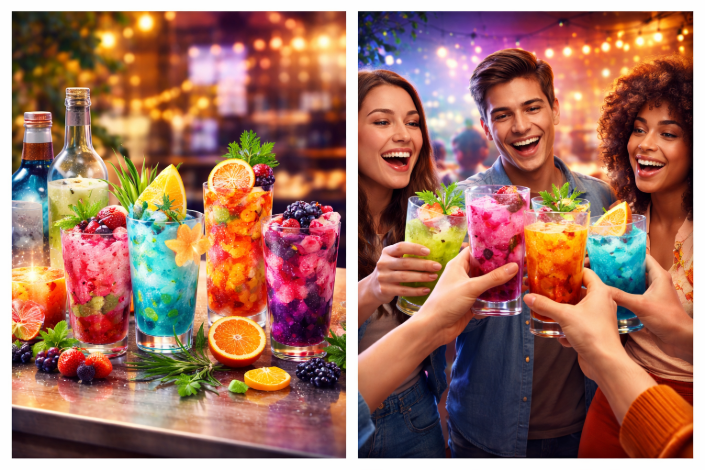
Sober-curious events in the US grew 92% year over year (comparing Aug 2024-Jul 2025 to the prior 12 months), ranging from morning dance parties to DJ nights centered on coffee rather than alcohol (per Eventbrite's report). This shift has a name: Sober Curious, choosing to drink less by preference rather than out of necessity, and treating sobriety as something you can bring to a social setting rather than hide.
For most of Gen Z, Sober Curious doesn't mean giving up alcohol entirely, it means drinking to fit the occasion. Per IWSR's December 2025 data, alcohol abstinence among Gen Z dropped by 9 to 10 percentage points year over year in the UK and Italy, and US tracking data shows 73% of Gen Z had a drink in the past six months. What's actually driving mocktail growth is this flexibility to switch in and out of drinking depending on the moment, drinking with intention rather than not drinking at all.
Inside a Mocktail Build
Picture a mocktail built from smoked juniper and fermented kombucha, garnished with dried citrus peel and a small sprig of smoked rosemary. The first thing a guest notices is the smoky aroma, then the tart fizz of the kombucha, then a faint burning finish that reads almost like spirits, before it registers that there's no alcohol in the glass at all. That moment when the body reacts before the brain catches up is exactly what mocktail developers are chasing in 2026.
A Dual Evolution: Visuals and Flavor in Mocktail 2.0
Giving up alcohol doesn't mean giving up the social experience. Consumers don't want a plain juice or a sugary soda. They want a drink that looks and tastes like it took real craft.
Building an Alcohol-Like Structure
The keyword for 2026 mocktails is structure. Developers are extracting wormwood, juniper, and smoky wood notes, sometimes using kombucha or non-alcoholic fermented bases, to recreate the burn and aftertaste of spirits without the alcohol, so the drinker keeps the same sense of ritual in a social setting.
A Drink Worth Photographing
In an era where the photo comes before the first sip, presentation matters. Proper barware, hand-cut ice, and color gradients built from natural plant pigments make a mocktail just as shareable as a cocktail, so drinkers stay part of the moment even without alcohol in the glass.
Adding Function: Making Socializing More Deliberate
The 2026 version of non-alcoholic drinks isn't just about removing alcohol, it's also about adding function, such as ashwagandha or reishi extract as adaptogens. The global functional beverage market was worth about USD 164.7 billion in 2025 and is projected to reach USD 178.9 billion in 2026, growing to USD 315.9 billion by 2033, a CAGR of 8.5% (Grand View Research), and adaptogen drinks are one of the faster-growing slices of that category. The pitch is natural relaxation and reduced social anxiety without dulling the senses, which lines up with what younger drinkers say they want: relaxed, but still clear-headed.
Two Versions of a Social Drink
| Comparison |
Traditional Alcohol-Based Social Drinking |
Non-Alcoholic Mocktail Social Drinking |
| Physical Effect |
Brief high followed by sensory dulling |
Natural relaxation and focus through adaptogens |
| The Next Day | Dehydration, hangover, poor sleep | Low calorie, hydrating, functional nutrition |
| Where the Mood Comes From | Relies on alcohol as a catalyst | Craft and conversation carry the atmosphere |
What This Means for Retailers and Brands
The practical takeaway for sourcing and buying teams isn't whether to chase this trend with one mocktail SKU. It's how to serve both alcoholic and non-alcoholic demand from the same product logic:
- One base, two formulas: BOBA CHiC's Cocktail Popping Boba Kit shares the same visual and textural design across its alcoholic and non-alcoholic versions, so retailers can list both from a single development cycle instead of building a separate non-alcoholic line from scratch.
- Merchandising: Placing the non-alcoholic option next to the alcoholic one, rather than off in a separate corner, matches how people actually shop this category, choosing at the shelf depending on the occasion.
- Where it performs best: Corporate year-end parties, weeknight get-togethers, and wellness-oriented events tend to show stronger sell-through for non-alcoholic mocktails than standard alcoholic SKUs, worth flagging when planning seasonal buys.
For the full spec on the dual-formula line, see BOBA CHiC's Cocktail Popping Boba Kit, or get in touch about distribution.
Closing
For beverage brands and retailers, the question isn't whether to offer a non-alcoholic option. It's what craft and story make not drinking feel just as considered as drinking does. Sober Curious isn't replacing alcohol-based socializing, it's adding a second option with the same sense of ritual.